10th International Guitar Festival Jüchen
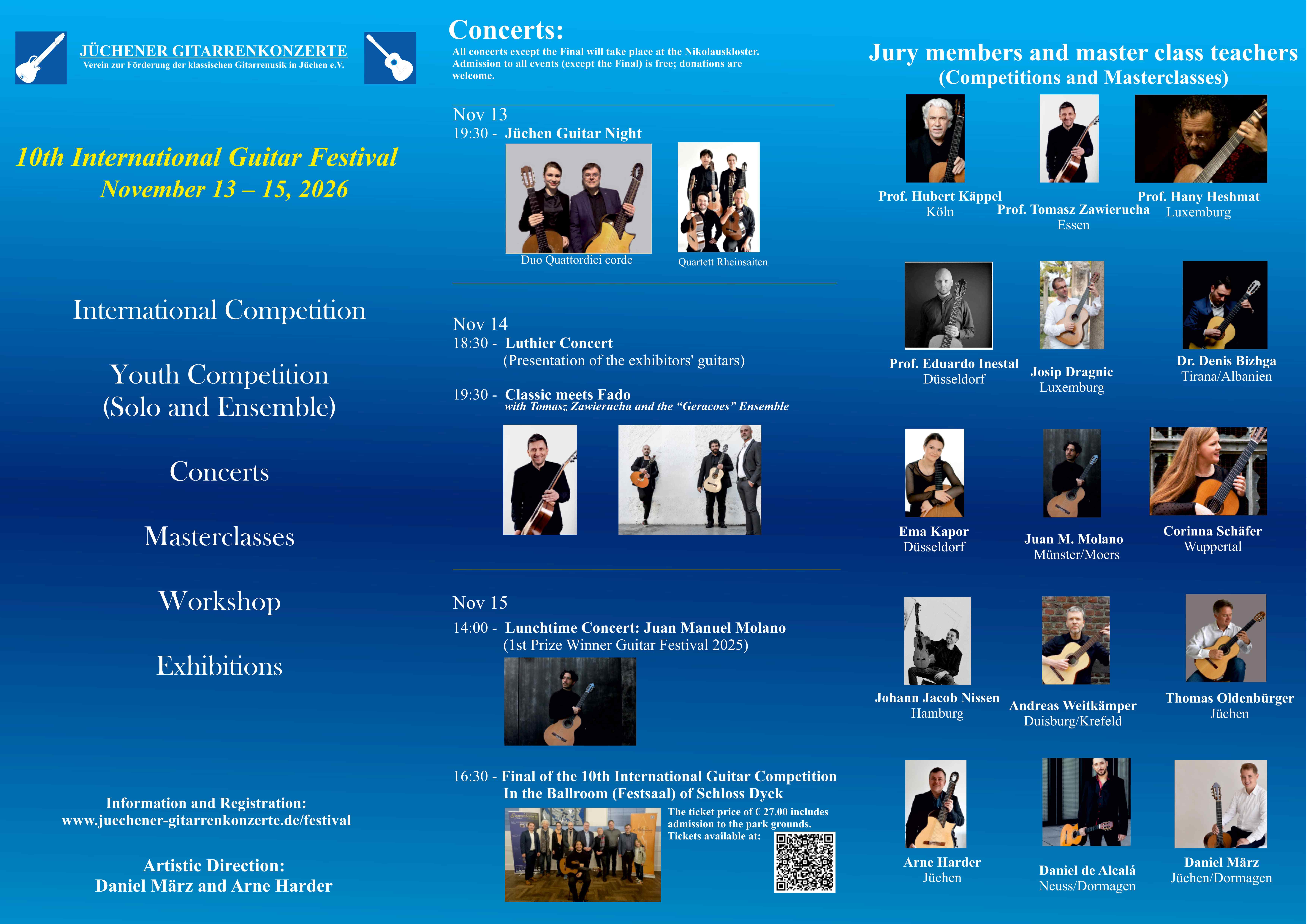
November 13–15, 2026, set in the wonderful ambiance of the Nikolauskloster and Dyck Castle.
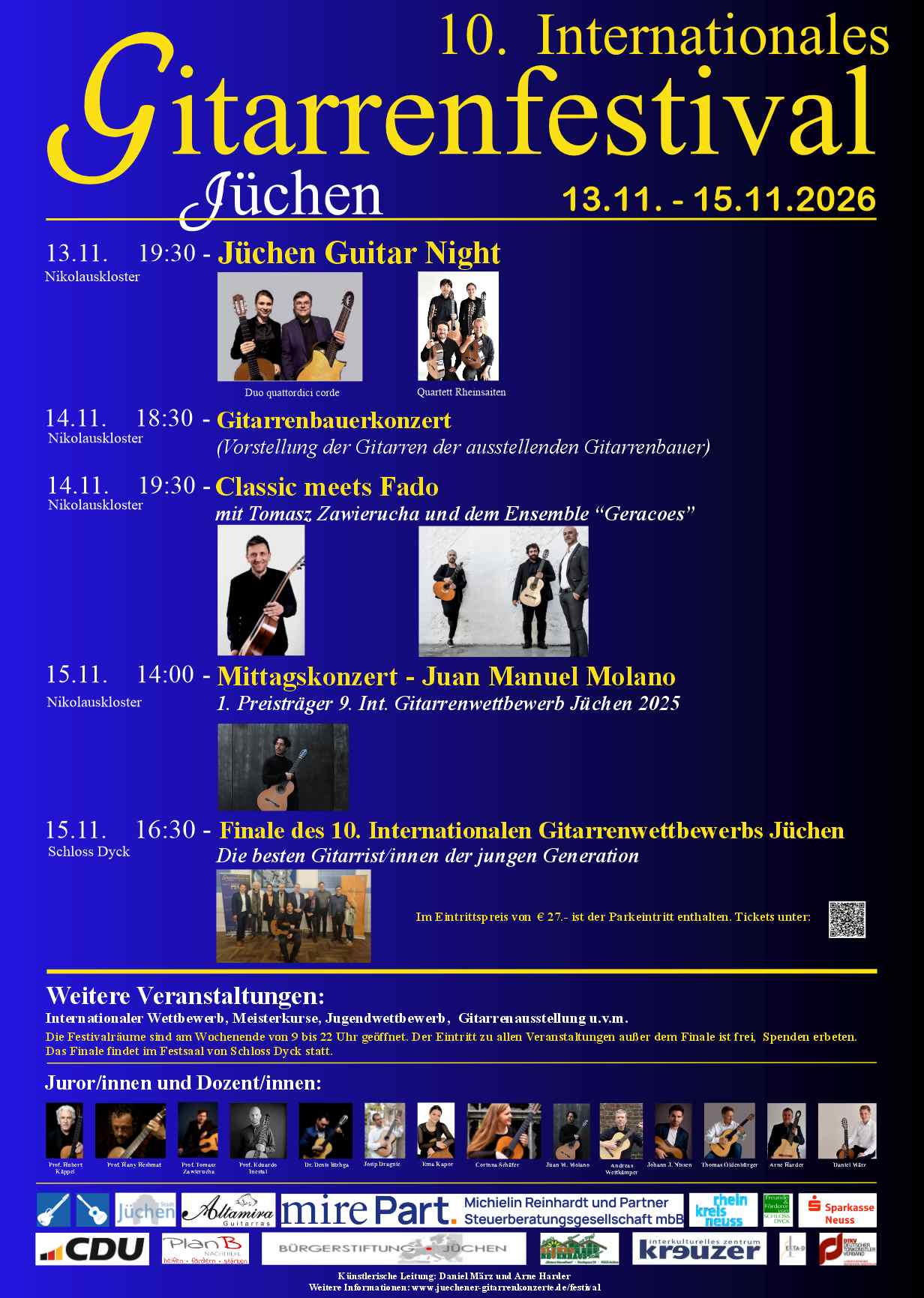
Festival Flyer 2026
Discover the official flyer and all details about the upcoming festival.

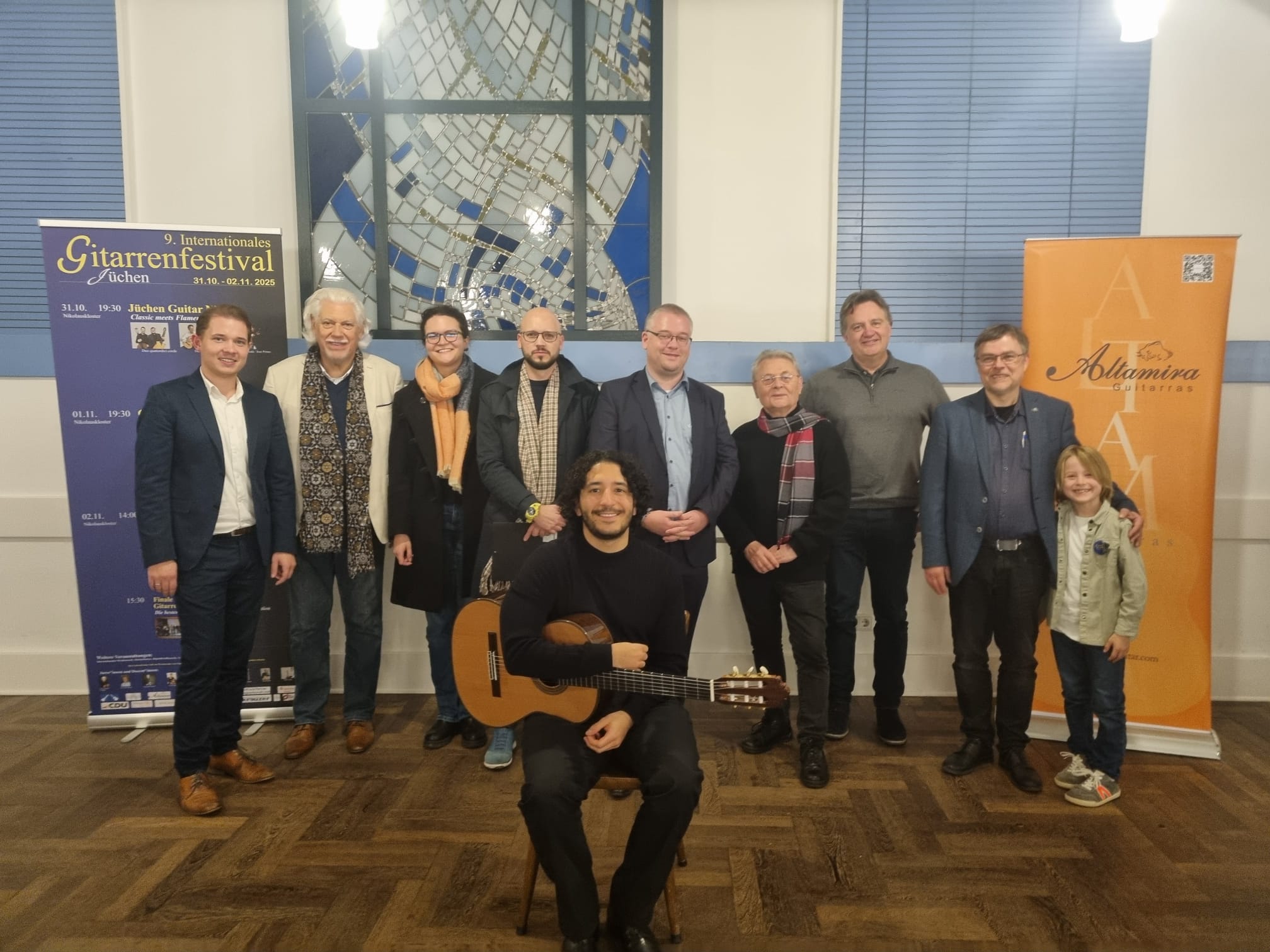
Review: 9th Guitar Festival Jüchen (2025)
It was a wonderful festival in 2025 in the inspiring atmosphere of the Nikolauskloster! Warm congratulations to the winners of the International Competition:
- 1st Prize: Juan Manuel Molano Posada (Colombia)
- 2nd Prize: Benno Panhans (Germany)
- 3rd Prize: Emilie Fend (France) / Seonghyeon Cho (South Korea)
The Association
Verein zur Förderung der klassischen Gitarrenmusik in Jüchen e.V.
The association exclusively and directly pursues non-profit purposes (promotion of art and culture, education, and international understanding). This is realized in particular through the support and organization of cultural projects, the International Guitar Festival Jüchen, concerts, and masterclasses/workshops.
Membership
Membership fees and donations are tax-deductible.
Documents & Bylaws
The association is based in Jüchen and is registered in the register of associations at the Local Court of Mönchengladbach.
Membership Application Form Association Bylaws / StatutesContact / Registration / Reservations
Artistic Directors


Address
Arne Harder
Fallerstr. 59
41363 Jüchen
Germany
Telephone & Fax
Tel.: +49 (0) 2165 879 780
Fax: +49 (0) 32122427337
Email (Registration / Reservations)
juechener-gitarrenkonzerte@web.de
Legal Notice (Impressum)
Information pursuant to Section 5 German Telemedia Act (TMG):
Arne Harder
Fallerstr. 59
41363 Jüchen
Germany
Contact:
Telephone: +49 (0) 2165 879 780
Fax: +49 (0) 32122427337
Email: arne.harder@web.de
Liability for Contents
The contents of our pages have been created with the utmost care. However, we cannot assume any liability for the correctness, completeness, and topicality of the contents. As a service provider, we are responsible for our own content on these web pages according to Section 7, Paragraph 1 of the German Telemedia Act (TMG) under general laws. According to Sections 8 to 10 of the TMG, we are not obligated to monitor transmitted or stored third-party information or to investigate circumstances that indicate illegal activity. Obligations to remove or block the use of information under general legal provisions remain unaffected. Any liability in this respect is only possible from the date of knowledge of a specific infringement. Upon becoming aware of any such legal violations, we will remove this content immediately.
Liability for Links
Our website contains links to external websites of third parties over whose contents we have no control. Therefore, we cannot assume any liability for these external contents. The respective provider or operator of the linked pages is always responsible for the contents of these pages. The linked pages were inspected for possible legal violations at the time of linking. Unlawful contents were not recognizable at the time of linking. However, continuous monitoring of the contents of the linked pages is not reasonable without specific indications of a legal violation. Upon notification of violations, we will remove such links immediately.
Copyright
The content and works published on these pages created by the site operators are subject to German copyright law. Duplication, processing, distribution, and any kind of commercialization beyond the scope of copyright law require the prior written consent of the respective author or creator. Downloads and copies of this site are only permitted for private, non-commercial use. Insofar as the content on this site was not created by the operator, the copyrights of third parties are respected. In particular, third-party content is identified as such. Should you nevertheless become aware of a copyright infringement, please inform us accordingly. Upon notification of legal violations, we will remove such content immediately.
Data Protection
The use of this website is generally possible without providing personal data. We would like to point out that data transmission over the Internet (e.g., communication via email) may involve security gaps. Complete protection of data against unauthorized access by third parties is not possible.
The use of contact data published within the scope of the legal notice obligations by third parties for sending unsolicited advertising and information materials is hereby expressly prohibited. The operators of these pages expressly reserve the right to take legal action in the event of unsolicited promotional information, such as spam emails.
Privacy Policy (Datenschutzerklärung)
This privacy policy informs you about the nature, scope, and purpose of the processing of personal data (hereinafter referred to as "Data") within our online services and associated websites, features, and content, as well as external online presences, such as our social media profiles (hereinafter collectively referred to as "Online Offer"). With regard to the terms used, such as "processing" or "controller," we refer to the definitions in Art. 4 of the General Data Protection Regulation (GDPR).
Controller
Arne Harder
Fallerstr. 59
41363 Jüchen
Germany
juechener-gitarrenkonzerte@web.de
Types of Processed Data
- Inventory data (e.g., master data of persons, names, or addresses).
- Contact details (e.g., email, telephone numbers).
- Content data (e.g., text entries, photographs, videos).
- Usage data (e.g., visited websites, interest in content, access times).
- Meta/communication data (e.g., device information, IP addresses).
Categories of Data Subjects
Visitors and users of the online offer (hereinafter collectively referred to as "Users").
Purpose of Processing
- Provision of the online offer, its functions, and contents.
- Responding to contact inquiries and communicating with users.
- Security measures.
- Audience measurement / marketing.
Terminology Used
"Personal data" means any information relating to an identified or identifiable natural person (hereinafter "Data Subject"); an identifiable natural person is one who can be identified, directly or indirectly, in particular by reference to an identifier such as a name, an identification number, location data, an online identifier (e.g., cookie), or to one or more factors specific to the physical, physiological, genetic, mental, economic, cultural, or social identity of that natural person.
"Processing" means any operation or set of operations performed on personal data or on sets of personal data, whether or not by automated means. The term is broad and covers virtually any handling of data.
"Pseudonymisation" means the processing of personal data in such a manner that the personal data can no longer be attributed to a specific data subject without the use of additional information, provided that such additional information is kept separately and is subject to technical and organizational measures that ensure the personal data are not attributed to an identified or identifiable natural person.
"Profiling" means any form of automated processing of personal data consisting of the use of personal data to evaluate certain personal aspects relating to a natural person, in particular to analyze or predict aspects concerning that natural person's performance at work, economic situation, health, personal preferences, interests, reliability, behavior, location, or movements.
"Controller" means the natural or legal person, public authority, agency, or other body which, alone or jointly with others, determines the purposes and means of the processing of personal data.
"Processor" means a natural or legal person, public authority, agency, or other body which processes personal data on behalf of the controller.
Relevant Legal Bases
In accordance with Art. 13 GDPR, we inform you of the legal bases for our data processing. For users from the territorial scope of the General Data Protection Regulation (GDPR), i.e., the EU and the EEA, the following applies unless the legal basis is expressly specified in the privacy policy:
The legal basis for obtaining consent is Art. 6(1)(a) and Art. 7 GDPR;
The legal basis for processing to perform our services, carry out contractual measures, and reply to inquiries is Art. 6(1)(b) GDPR;
The legal basis for processing to fulfill our legal obligations is Art. 6(1)(c) GDPR;
In the event that vital interests of the data subject or another natural person require data processing, Art. 6(1)(d) GDPR serves as the legal basis.
The legal basis for necessary processing to perform a task carried out in the public interest or in the exercise of official authority vested in the controller is Art. 6(1)(e) GDPR.
The legal basis for processing to safeguard our legitimate interests is Art. 6(1)(f) GDPR.
The processing of data for purposes other than those for which they were collected is governed by the provisions of Art. 6(4) GDPR.
The processing of special categories of data (in accordance with Art. 9(1) GDPR) is governed by the provisions of Art. 9(2) GDPR.
Security Measures
In accordance with legal requirements and taking into account the state of the art, implementation costs, the nature, scope, context, and purposes of processing, as well as the varying likelihood and severity of the risk to the rights and freedoms of natural persons, we take appropriate technical and organizational measures to ensure a level of security appropriate to the risk.
The measures include, in particular, safeguarding the confidentiality, integrity, and availability of data by controlling physical and logical access to the data, as well as access, entry, transfer, ensuring availability, and separation of data. Furthermore, we have established procedures that ensure the exercise of data subject rights, the erasure of data, and responses to data hazards. In addition, we take the protection of personal data into account as early as the development or selection of hardware, software, and procedures, in accordance with the principle of data protection by design and by default.
Cooperation with Processors, Joint Controllers, and Third Parties
If, in the context of our processing, we disclose data to other persons and companies (processors, joint controllers, or third parties), transmit it to them, or otherwise grant them access to the data, this is done only on the basis of a legal permission (e.g., if transmission of data to third parties, such as payment service providers, is required for contract performance), users have consented, a legal obligation provides for this, or on the basis of our legitimate interests (e.g., when using agents, web hosts, etc.).
If we disclose, transmit, or otherwise grant access to data to other companies within our corporate group, this is done in particular for administrative purposes based on a legitimate interest and beyond that on a legal basis conforming to statutory requirements.
Transfers to Third Countries
If we process data in a third country (i.e., outside the European Union (EU), the European Economic Area (EEA), or the Swiss Confederation) or this occurs in the context of using third-party services or disclosure/transfer of data to other persons or companies, this is done only if necessary to fulfill our (pre-)contractual obligations, based on your consent, on the basis of a legal obligation, or on the basis of our legitimate interests. Subject to legal or contractual authorizations, we process or have the data processed in a third country only if the statutory conditions are met. This means processing takes place, for example, on the basis of special guarantees, such as the officially recognized determination of a data protection level corresponding to the EU or compliance with officially recognized special contractual obligations.
Rights of Data Subjects
You have the right to request confirmation as to whether relevant data is being processed, to obtain information about such data, and to receive further information and a copy of the data in accordance with statutory requirements.
You have the right, in accordance with statutory requirements, to request the completion of data concerning you or the rectification of inaccurate data concerning you.
In accordance with statutory requirements, you have the right to demand that data concerning you be erased without undue delay or, alternatively, to request restriction of data processing in accordance with statutory requirements.
You have the right to demand to receive the data concerning you that you have provided to us in accordance with statutory provisions, and to request its transfer to other controllers.
Furthermore, you have the right, under statutory regulations, to lodge a complaint with the competent supervisory authority.
Right of Withdrawal
You have the right to withdraw consents granted with effect for the future.
Right to Object
You may object at any time to the future processing of data concerning you in accordance with statutory requirements. The objection may be made in particular against processing for direct marketing purposes.
Cookies and Right to Object in Direct Advertising
"Cookies" are small files stored on users' computers. Various kinds of data can be stored within cookies. A cookie primarily serves to store information about a user (or the device on which the cookie is stored) during or after their visit to an online service. Temporary cookies, or "session cookies" / "transient cookies," are cookies that are deleted after a user leaves an online offer and closes their browser. Such a cookie may, for instance, store the contents of a shopping cart in an online shop or a login status. "Permanent" or "persistent" cookies are those that remain stored even after the browser is closed. For example, the login status can be retained when users return after several days. Similarly, user interests can be stored in such a cookie, which are then used for audience measurement or marketing purposes. "Third-party cookies" are cookies offered by providers other than the controller operating the online offer (otherwise, if they are only the operator's cookies, they are called "first-party cookies").
We may use temporary and permanent cookies and clarify this within our privacy policy.
If users do not want cookies stored on their computer, they are requested to disable the corresponding option in their browser's system settings. Stored cookies can be deleted in the browser's system settings. The exclusion of cookies may lead to functional limitations of this online service.
A general objection to the use of cookies used for online marketing purposes can be declared for a variety of services, especially in the case of tracking, via the US website http://www.aboutads.info/choices/ or the EU website http://www.youronlinechoices.com/. Furthermore, the storage of cookies can be prevented by disabling them in the browser settings. Please note that you might not be able to use all features of this online offer in that case.
Erasure of Data
The data processed by us will be erased or restricted in its processing in accordance with statutory requirements. Unless explicitly stated in this privacy policy, data stored by us will be deleted as soon as it is no longer required for its intended purpose and no statutory retention obligations prevent its erasure.
If data is not erased because it is required for other and legally permissible purposes, its processing will be restricted. That is, the data is blocked and not processed for other purposes. This applies, for example, to data that must be retained for commercial or tax reasons.
Changes and Updates to the Privacy Policy
We ask you to inform yourself regularly about the content of our privacy policy. We modify the privacy policy as soon as changes in the data processing activities carried out by us make this necessary. We will inform you as soon as the changes require an act of cooperation on your part (e.g., consent) or any other individual notification.
Performance of Statutory and Business Services
We process the data of our members, supporters, interested parties, customers, or other persons in accordance with Art. 6(1)(b) GDPR, insofar as we offer them contractual services or act within the scope of existing business relations, e.g., towards members, or are recipients of services and grants ourselves. In addition, we process the data of data subjects in accordance with Art. 6(1)(f) GDPR based on our legitimate interests, e.g., regarding administrative tasks or public relations.
The data processed in this context, the nature, scope, purpose, and necessity of their processing are determined by the underlying contractual relationship. This generally includes inventory and master data of persons (e.g., name, address, etc.), contact data (e.g., email address, telephone, etc.), contract data (e.g., services used, communicated content and information, names of contact persons), and, if we provide paid services or products, payment data (e.g., bank details, payment history, etc.).
We delete data that is no longer required for fulfilling our statutory and business purposes. This is determined according to the respective tasks and contractual relationships. In the case of business processing, we retain the data for as long as it may be relevant for business management and with regard to any warranty or liability obligations. The necessity of retaining the data is reviewed every three years; otherwise, statutory retention obligations apply.
Created with Datenschutz-Generator.de by Atty. Dr. Thomas Schwenke